|
||
| |
23. Decomposing Cohenite |
| Listing of Structures |
| Back...Next |
| Decomposing Cohenite in Iron Meteorites: Observations from Nantan, IAB |
| |
 |
| Figure
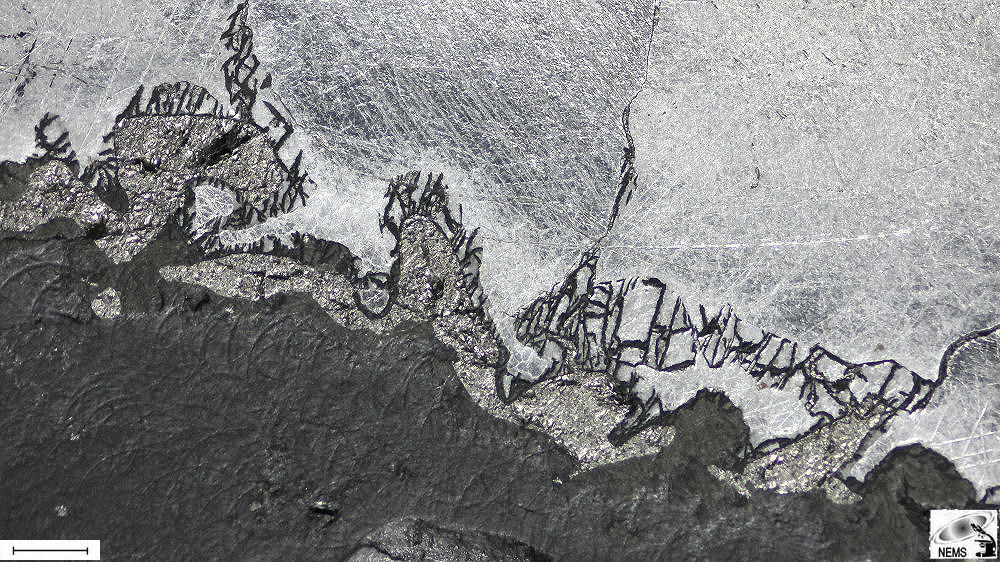
1. Decomposing cohenite surrounding kamacite in the Nantan IAB iron meteorite. Scale bar=1.2 mm. Mineralogy and Stability of Cohenite Cohenite ((FeNi)3C) is a primary iron carbide mineral that occurs almost exclusively in iron and stony-iron meteorites. It forms through solid-state reactions involving carbon dissolved in taenite (γ-FeNi) or austenite during slow cooling of the parent-body metal. Formation typically occurs within a relatively narrow temperature window of approximately 675°C to 610°C in alloys containing 6–8 wt% Ni; higher Ni contents generally inhibit cohenite stability. The required carbon is sourced from the surrounding metallic matrix. Below ~610°C, cohenite becomes thermodynamically unstable relative to kamacite (α-FeNi) + graphite. Decomposition proceeds via exsolution and graphitization: cohenite breaks down into Fe-Ni metal and elemental carbon, which nucleates as graphite inclusions or veins. This process is kinetically controlled and strongly dependent on: • Nickel content (higher Ni slows decomposition). • Cooling rate (prolonged time in the critical temperature range promotes graphitization). • Presence of nucleation sites (e.g., interfaces with kamacite or other phases). Schreibersite ((FeNi)3P), by contrast, has a broader stability field, nucleating as high as ~850°C and continuing down to ~400°C. Decomposition Textures in Nantan The Nantan IAB iron meteorite displays classic examples of decomposing cohenite (Figures 1 and 2). The carbide occurs in association with kamacite, showing irregular margins and internal graphite precipitation indicative of ongoing breakdown. IAB irons, often linked to impact-melt or incompletely differentiated parent bodies, commonly preserve such transitional textures due to their complex thermal histories. Broader Implications The formation and decomposition of cohenite serve as sensitive recorders of thermal evolution in asteroidal cores. Quantitative analysis of cohenite abundance, grain size, and degree of graphitization helps refine metallographic cooling rates and reconstruct parent-body thermal models. In many irons, partial decomposition reflects the transition from high-temperature carbide stability to low-temperature graphite dominance, mirroring phase equilibria in the Fe-Ni-C system. Cohenite decomposition also has implications for carbon cycling in the early solar system and the potential delivery of reduced carbon phases to terrestrial planets via meteoritic bombardment. Advanced techniques such as transmission electron microscopy (TEM) and Raman spectroscopy can further elucidate nanoscale mechanisms of graphitization and the role of trace elements in stabilizing or destabilizing cohenite. |
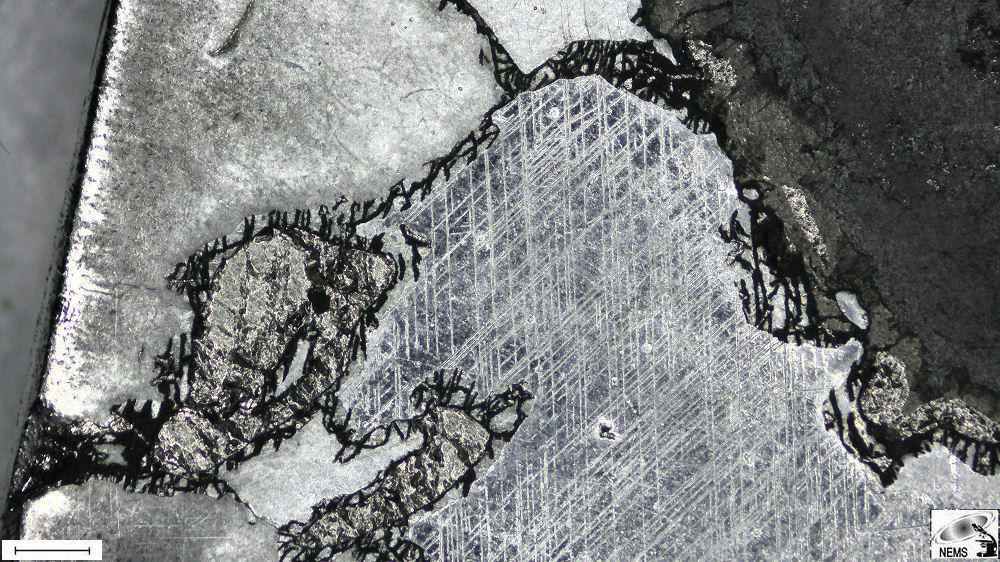
| Figure 2. Scale bar 1.2 mm |
| Meteorite, Nantan, IAB |
| Decomposing cohenite surrounding kamacite. |
| References
• Buchwald, V. F. (1975). Handbook of Iron Meteorites. University of California Press. (Detailed descriptions of cohenite textures and stability in iron meteorites.) • Standard phase diagram studies in the Fe-Ni-C system (e.g., works by Goldstein and others in meteoritical and materials science literature). • Meteoritical Bulletin Database (for Nantan classification and context). |
| Listing of Structures |